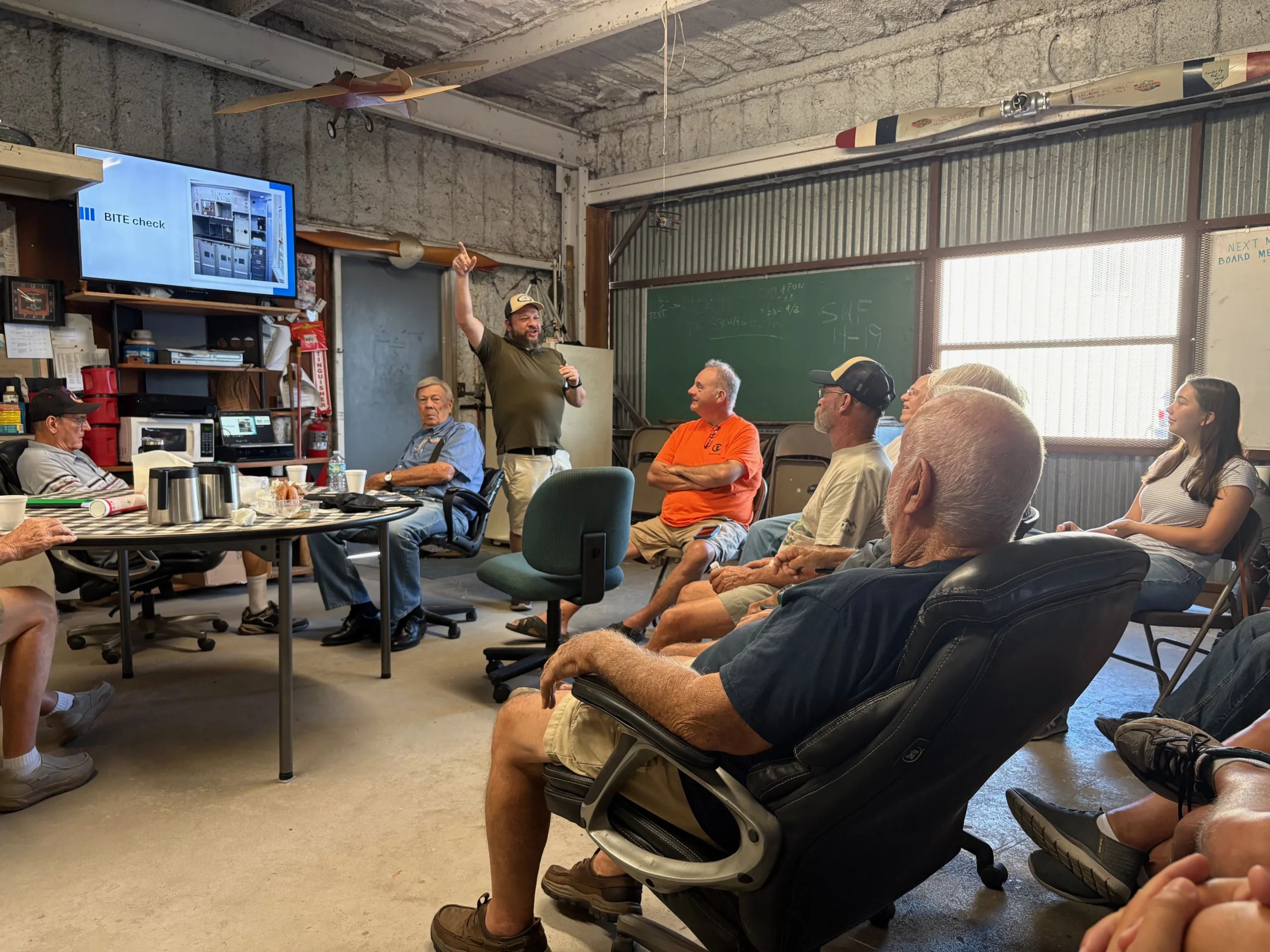
Eduardo Guerra pointed at the screen and asked the room a question nobody in Chapter 229 gets to answer in real life: “Anybody know what BITE stands for?” A dozen hands went up. A dozen guesses came back wrong. Eduardo laughed, corrected the room — Built-In Test Equipment — and kept moving. For the next hour, a Delta Air Lines TechOps training instructor pulled back the curtain on what actually happens between the moment an international widebody touches down and the moment it takes off again, and Hangar 100 didn’t want him to stop.
An A&P Who Works the Big Iron
Eduardo is an Airframe & Powerplant mechanic — an A&P — at Delta Airlines; for many years his job was turning international widebodies: getting a jet that just crossed an ocean ready to cross another one, usually on a clock measured in hours, not days. He’s worked flights into Amsterdam, London, and points well beyond, and he came to our August 1st meeting to talk about a side of aviation most of our members never see from the cabin.
Reciprocity, Open Skies, and the Shortest Flight You’ll Ever Board
Ed as he liked to be called, opened with the framework that governs who flies where. For decades, international air service ran on reciprocity agreements — if you wanted to fly into my country, I got to fly into yours. It sounded fair, but it protected weak carriers and blocked routes that made sense. Most of the world has since moved to open skies agreements: follow the FAA’s safety and reliability standards, and you’re allowed to fly, full stop.
That system produces some strange bookends. The shortest international flight in the U.S. right now is American Airlines’ Miami–Bimini run — 35 minutes, barely enough time to reach cruise. The longest is Singapore Airlines’ JFK–Singapore route, nearly 19 hours nonstop. Ed’s own logbook has one memorable entry or two: he worked Delta’s ReInaugural Amsterdam–Tampa flight back in 2022, and Virgin Atlantic London to Tampa, the first time that route ever touched Tampa soil.
Walking the Jet
Once a widebody parks at the gate, the mechanic’s job starts before the last passenger is off the jet bridge. Eduardo walked the room through his routine: wait for the cabin to clear, then do a walkaround — check that “all the big pieces are still there,” in his words — followed by a BITE check, where the aircraft’s onboard computers report which systems are flagging trouble on their own.
Then it’s the logbook. Every write-up from the inbound crew has to be addressed — fixed, acknowledged, or deferred. Eduardo told the room about one that stuck with him: gouge marks circling the fan blades on an engine, source unknown, that had to be measured against tolerance limits before he could sign the jet off as airworthy. That’s where the MEL comes in — the Minimum Equipment List, built from the aircraft manufacturer’s master list (MMEL), which spells out exactly what can be broken and for how long before it must be fixed. Depending on the system, a deferral can run anywhere from three days to 120.
Most of these flights operate under ETOPS — Extended-range Twin-engine Operational Performance Standards, the rules that let twin-engine jets fly far from land over open water. Eduardo’s version of the acronym got a laugh: “Engines Turn Or Passengers Swim.” What started as a 60-minute diversion limit from a suitable airport has grown to as much as 5.5 hours, letting today’s twins fly routes that once required four engines.
Questions From the Floor
The Q&A ran almost as long as the talk. Rick asked about tire pressure — 260 psi on the mains, 210 on the nose for an A330 (the average life of a A330 MLG (main landing gear) tire for planing purposes is 300 cycles, one cycle is one take off and one landing), filled with nitrogen instead of shop air because the gas has to stay stable from a 150-degree ramp in Orlando to 60-below at cruise altitude. Steve and Michelle pushed on tire wear, and Eduardo set the record straight: commercial tires lose most of their rubber in tight turns on taxi, not from braking on the runway.
Tom asked how many landings a widebody tire is good for before it needs to come off — Eduardo didn’t have an exact number on hand, but promised to follow up. And when someone asked about the strangest thing he’s found on a walkaround, Eduardo didn’t hesitate: a turkey vulture strike on the nose, feathers and all, discovered mid-walkaround with the captain already radioing it in.
The lighter moments landed too — Eduardo crediting his old Delta colleague Doug for teaching him exactly which galley on which route kept the good chocolate, and which one had the leftover sandwiches. Every international mechanic, it turns out, has a favorite galley.
Join Us
Our thanks to Eduardo Guerra for giving Chapter 229 a mechanic’s-eye view of a world most of us only see from a window seat. If you missed it, join us for our next meeting — first Saturday of the month, Hangar 100, 9:00 AM. We’d love to see you on the ramp.