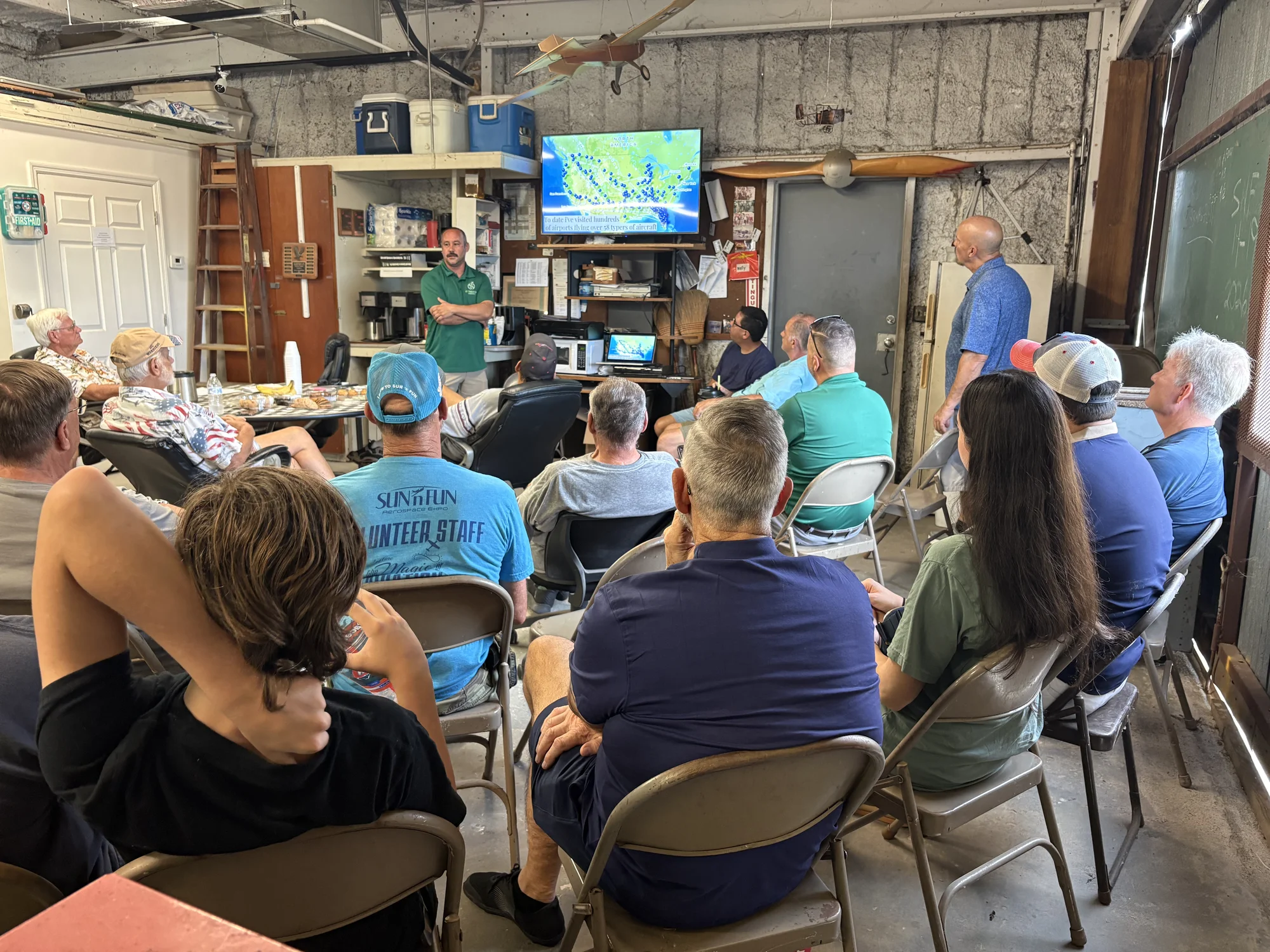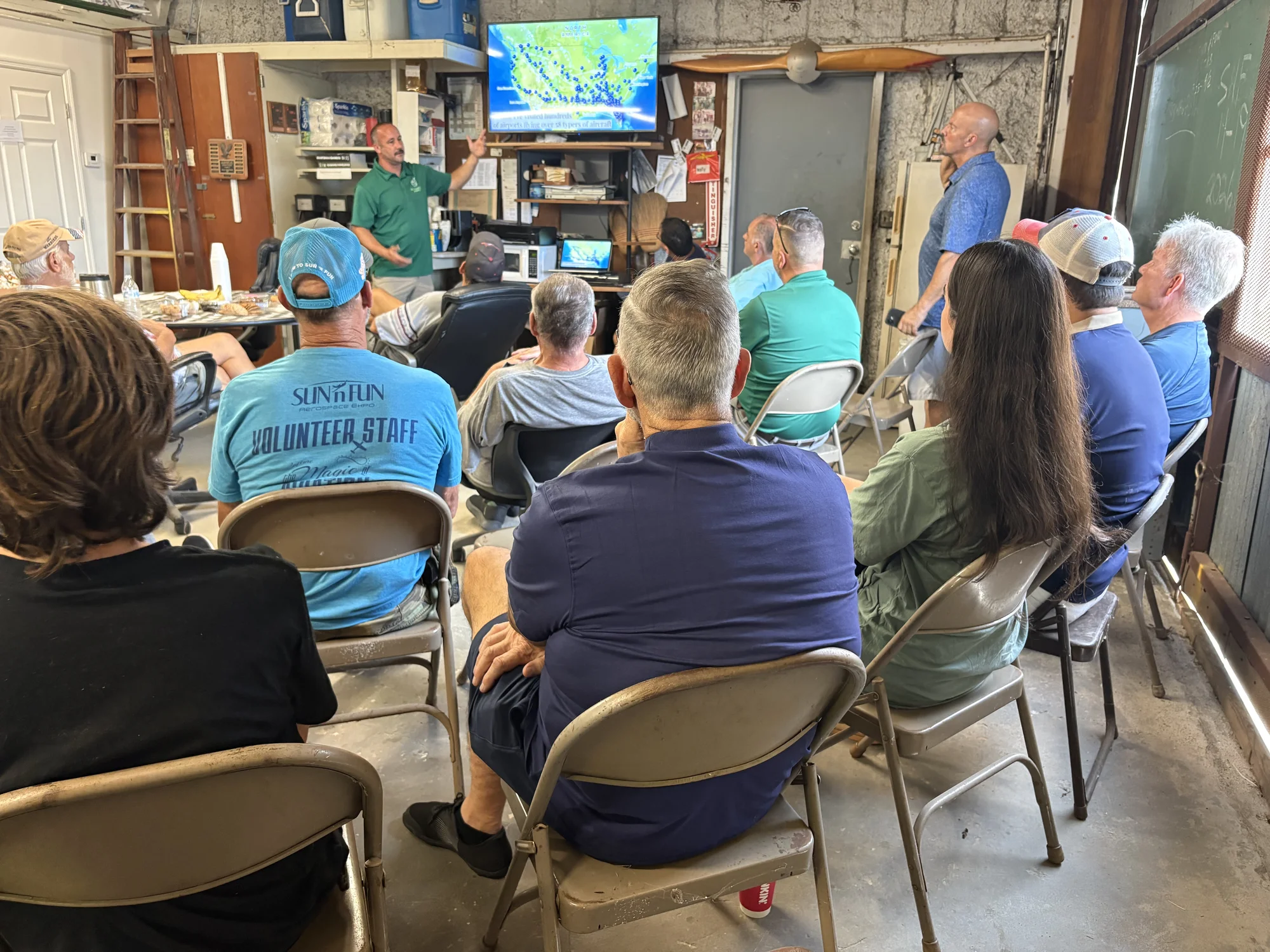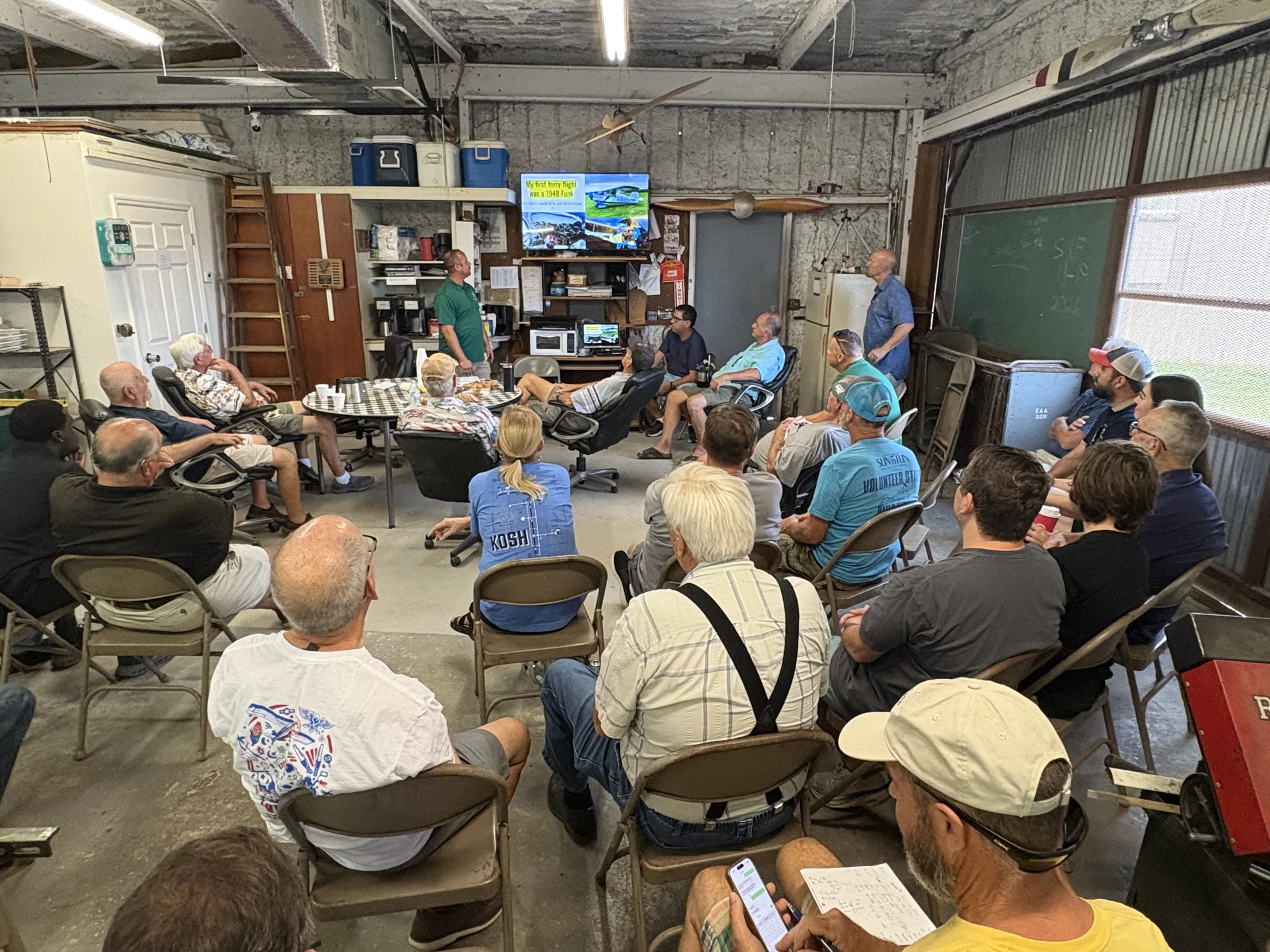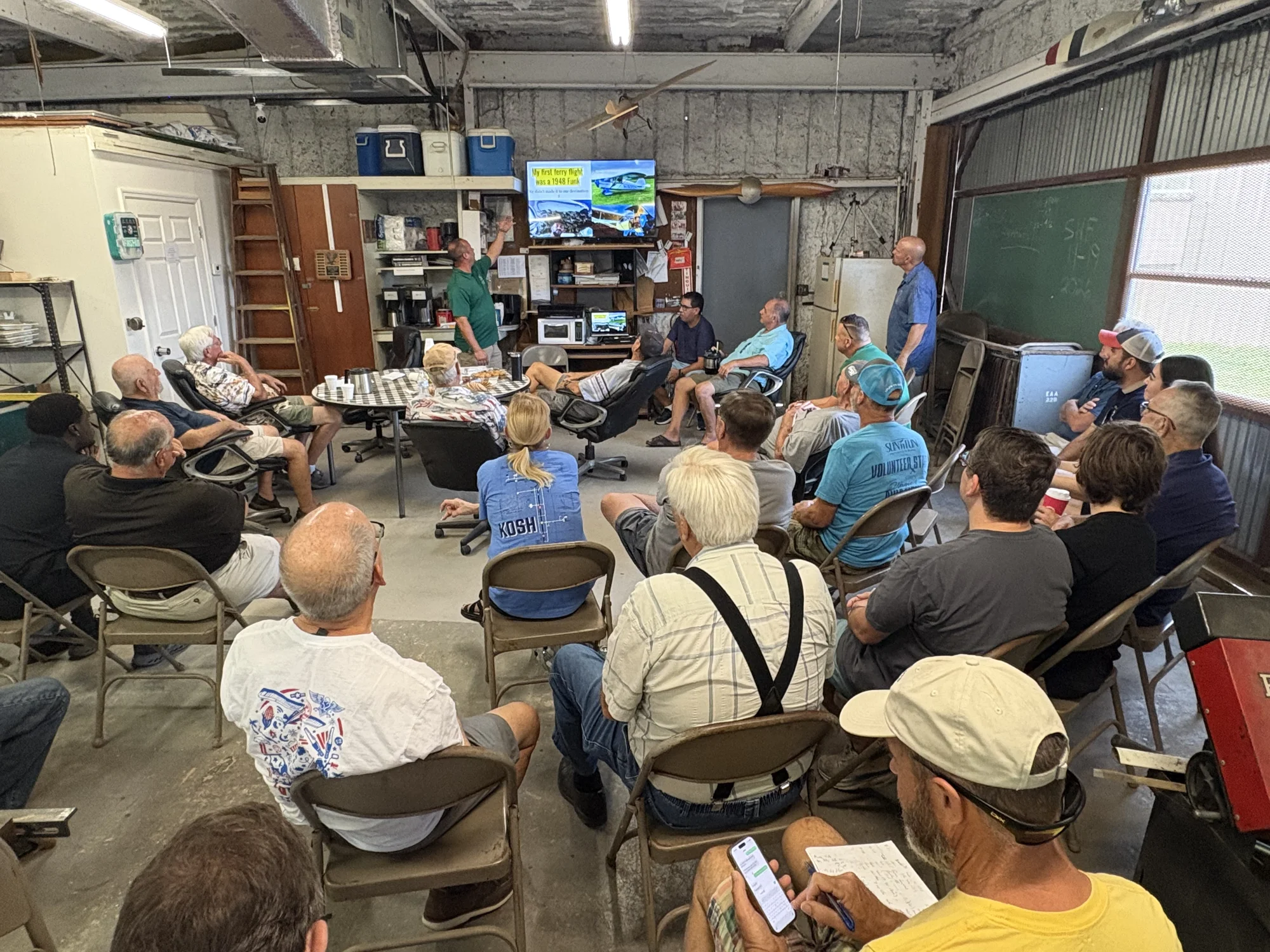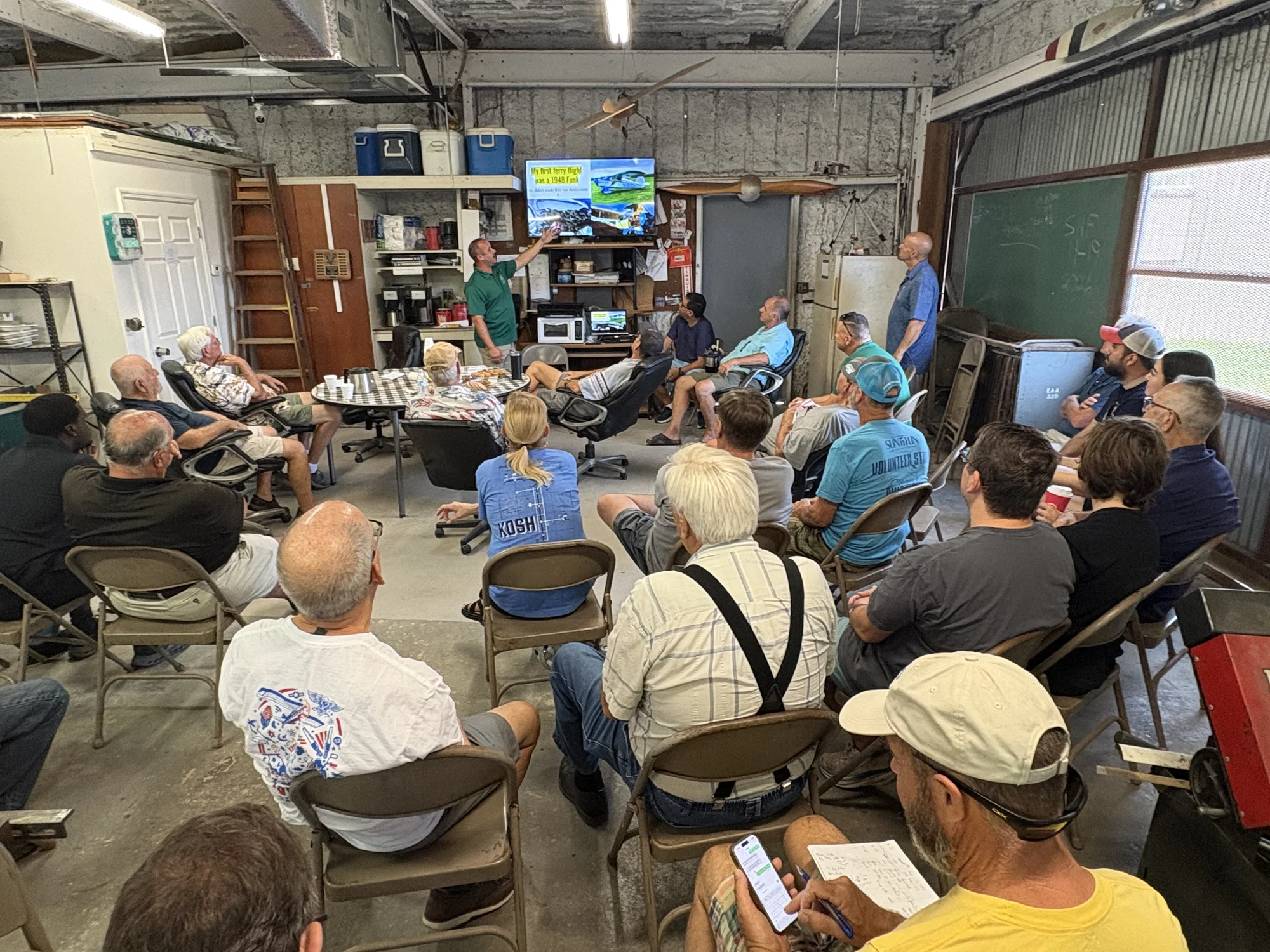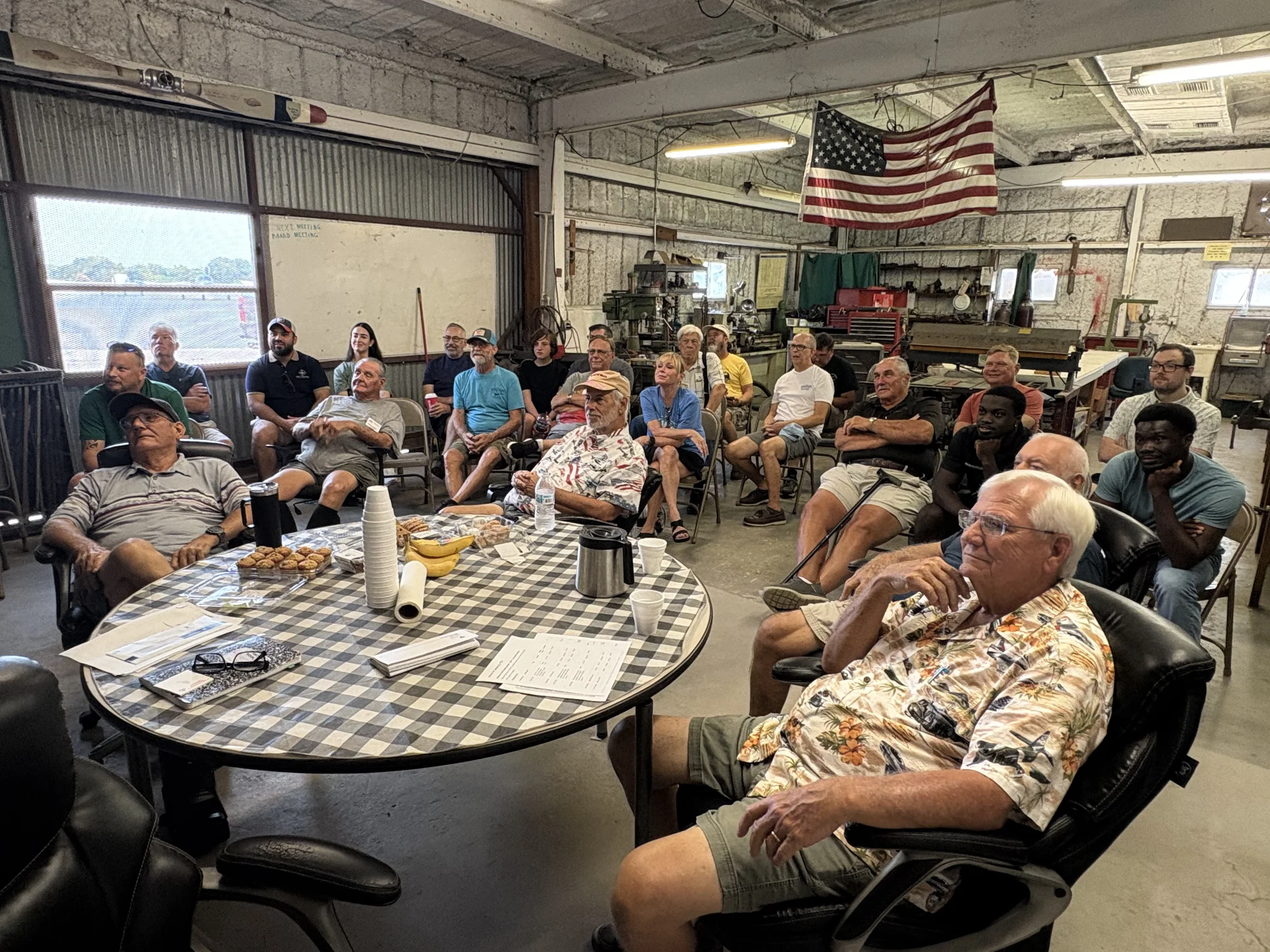
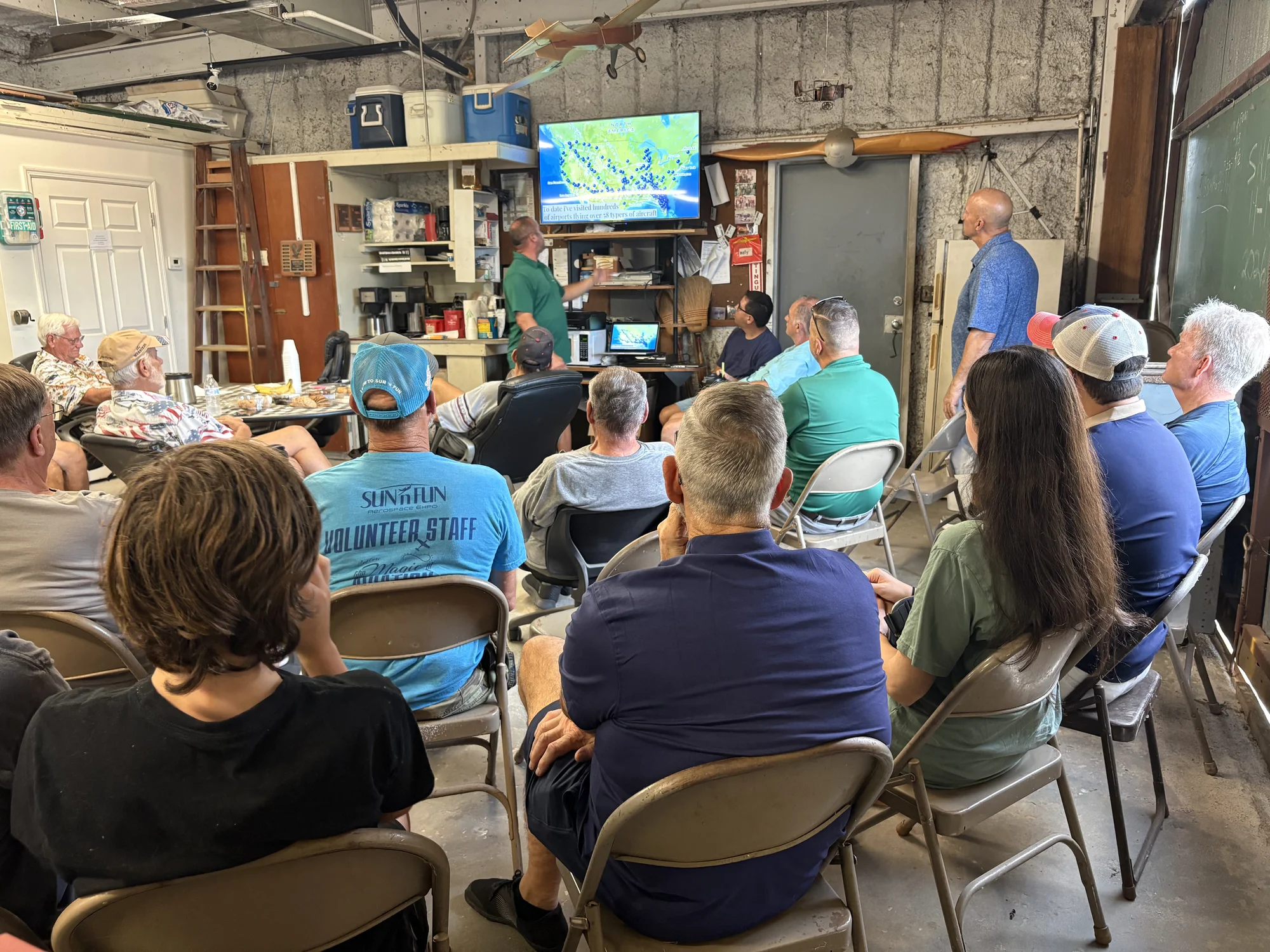
The first slide put a map of the United States on the TV at Hangar 100, and it was covered in blue pins. Coast to coast, border to border, hundreds of them. Patrick Blackwelder pointed at the screen and told a room full of folding chairs, coffee cups and Sun ‘n Fun volunteer shirts what each pin meant: a landing, usually somewhere he’d never been, in an airplane he’d often never flown.
Patrick is Chief Flight Instructor at Synergy Aero, right across from the FBO here at Winter Haven. He’s also a ferry pilot, which means people hand him the keys to their airplane and ask him to deliver it. At our October 3 meeting he told us what that has looked like: over 50 types of aircraft, one 1948 Funk, a seaplane that fought him across the country, and one police car he took by mistake.
From Washing Planes to Ultralights
Patrick grew up in Winter Haven. At about ten years old he and his friends washed airplanes for a few of the old-timers at the field, and the old-timers paid them in rides around town. Their parents knew nothing about it. “Cell phones didn’t track us back then,” he told the room.
Flying was out of reach until he was an adult, so he joined the Navy as an airframes mechanic, the person who keeps the structure of the aircraft sound. He worked on F-14s, EA-6B Prowlers and F/A-18s. When he got out he decided he’d rather fly airplanes than fix them, and he started with what he could afford.
That meant ultralights: a Lazair with two nine-horsepower two-stroke engines (light enough that he could shut both off in the air and glide), then a Challenger, then a Drifter. All three together cost less than $10,000. His point to the room was that getting airborne doesn’t have to be expensive.
Funks, Flat Tires and the Golden Gate
Over the past two and a half years, Patrick has delivered airplanes across the continental U.S., into Canada and out to New Mexico, plus a float-plane trip that he describes mostly as “a lot of paddling.”
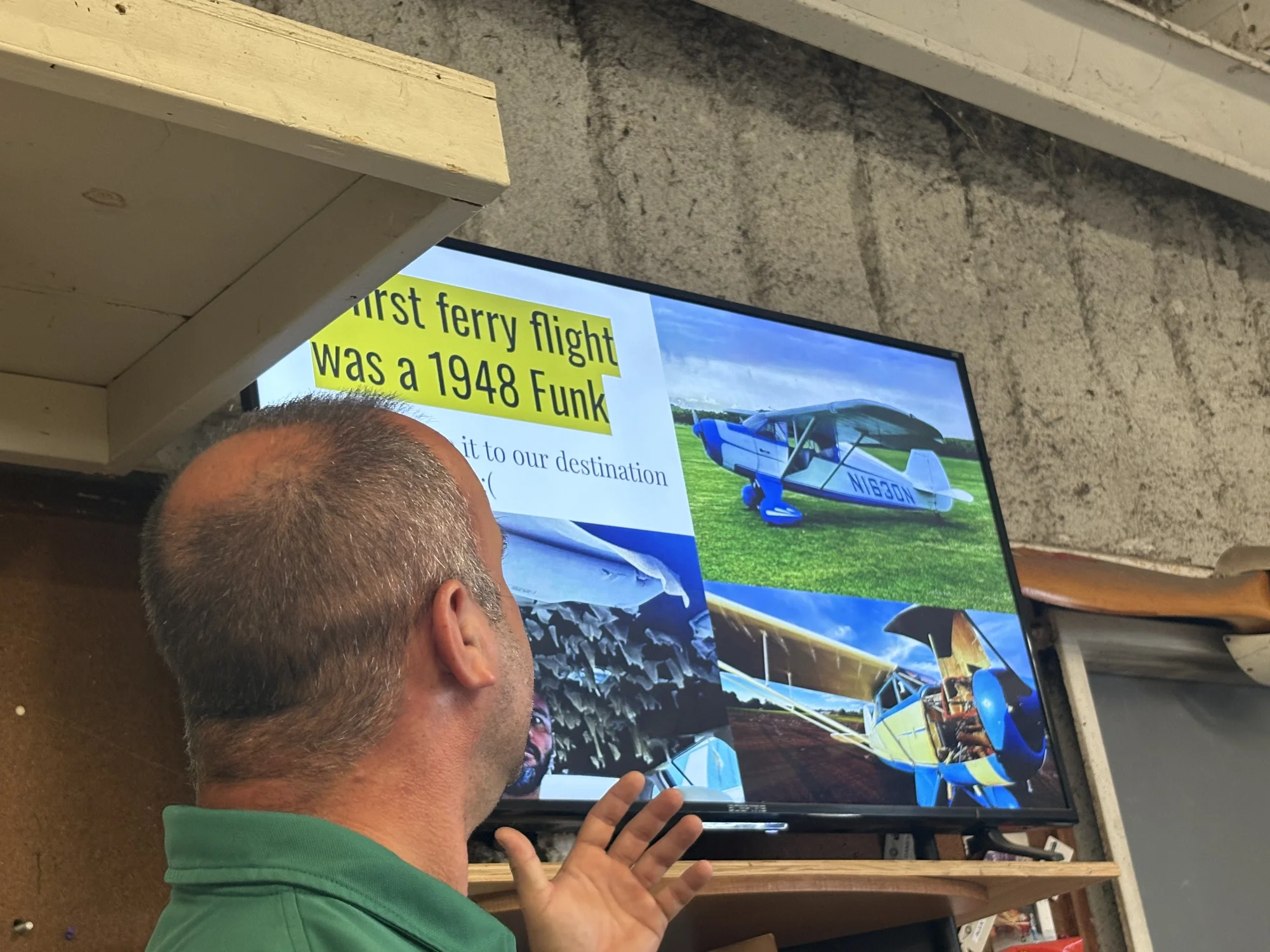
His first ferry flight was the 1948 Funk. The owner met him in Daytona, and the two of them headed for Bentonville, Arkansas. They made it as far as Winona, Mississippi, where Patrick learned his first big lesson: cheap fuel is not the only reason to pick an airport. It was a Sunday, nobody at the FBO would hand over the courtesy car keys, and it took more than eight hours, the local police department and a friend of a friend to get a car.
On a coast-to-coast delivery of a Remos for Eric, a friend who keeps his airplane in the 300 hangars here at the field, Patrick flew down the California coast past the Golden Gate Bridge, one of the most beautiful flights he has made. It was also pitch black at night, with no moon and almost nothing below. At a remote airfield he found a front tire nearly flat, and an air compressor in a mower shop. He topped off the tire, took off, and made Santa Rosa. The tire was flat again the next morning. A new tube from Tractor Supply fixed it.
His biggest takeaway wasn’t about fuel or tires. “Take a lot of pictures,” he said. He has flown the Golden Gate route five times since, and he’s glad he has the photos from the first.
Sleeping on FBO Couches
Patrick treats a client’s airplane budget like his own. He skips hotels, so he has slept on a lot of FBO couches and floors, and once in a pilot sleeping room with chairs that lay flat and a thermostat he cranked all the way down. Before he flies anywhere, he checks ForeFlight’s FBO information (restrooms, Wi-Fi, pilot lounge, hours) and the pilot reviews, and he asked everyone in the room to leave reviews too. “If you have a really bad experience, post a comment, because I don’t want to go there.”
His favorite stop is Brookhaven, Mississippi. The first time he landed there, he signed the courtesy car log, grabbed the keys and found a white Chevy with government tags in the lot. He drove to Taco Bell, came back and slept on the FBO couch. The next morning the FBO manager, who had the whole thing on camera, asked how he’d slept and told him the car was a police car. They’d even topped off the fuel. If you stop there, ask the manager about the hangar next door, which houses one of the first airline biplanes: wood and fabric, a huge radial, wicker seats all the way back.
He also likes 69V, a small field south of Salt Lake City with a courtesy car, showers, couches, and a Maverick gas station with a Subway across the road. It sits at the foot of a canyon wall, so takeoffs are a lesson in planning.
When Airplanes Fight Back
Patrick hasn’t had many airplanes get through a delivery without a surprise, and he told a few of the harder ones. The seaplane belonged to a YouTuber. Patrick had plenty of time in it and had taught the owner to land it on the water and on the runway. With Steve Watson, one of our members and Patrick’s right hand at Synergy, riding along, a 14-by-6-inch rudder trim tab let go in flight and swung the airplane about 70 degrees. Steve held the right rudder while Patrick found a workaround in the autopilot, and it took them an hour. That evening a wheel failed while they taxied. Patrick films everything on these trips, for liability and for what he learns from it.
Another time a mechanic’s repair, a $5,800 exhaust fix, was about to send him down the runway at Midland. He pulled all 34 screws off the engine cowling to check the work and found loose intake tubes and two exhaust screws missing. His rule is simple: “Don’t trust anyone, because it’s your life, not theirs.”
The last lesson was about transition training. An experienced professional pilot bought a Grumman, hadn’t flown it in a while, and bounced a landing at a nearby airport. The airplane has been in a shop for two years. Patrick checked out in a 172 at Bartow and hired a mountain-flying instructor for his own cross-country after a year away. He’ll gladly give anyone transition training in their own airplane.
Come Fly With Us
Patrick’s advice for anyone building time: ask a ferry pilot if you can ride along. He covers your food, you pay your way home, and you’ll probably sleep on a FBO couch. He flew to Oshkosh last year with a new sport pilot who had never been farther than Spring Hill. And whatever you fly, he said, don’t forget why you started. Synergy Aero has cameras you can borrow to film your own landings.
You can find Patrick and Steve at Synergy Aero, across from the FBO. Join us for our next meeting on Saturday, November 7, at 9:00 AM at Hangar 100. No commitment, just come on by.