
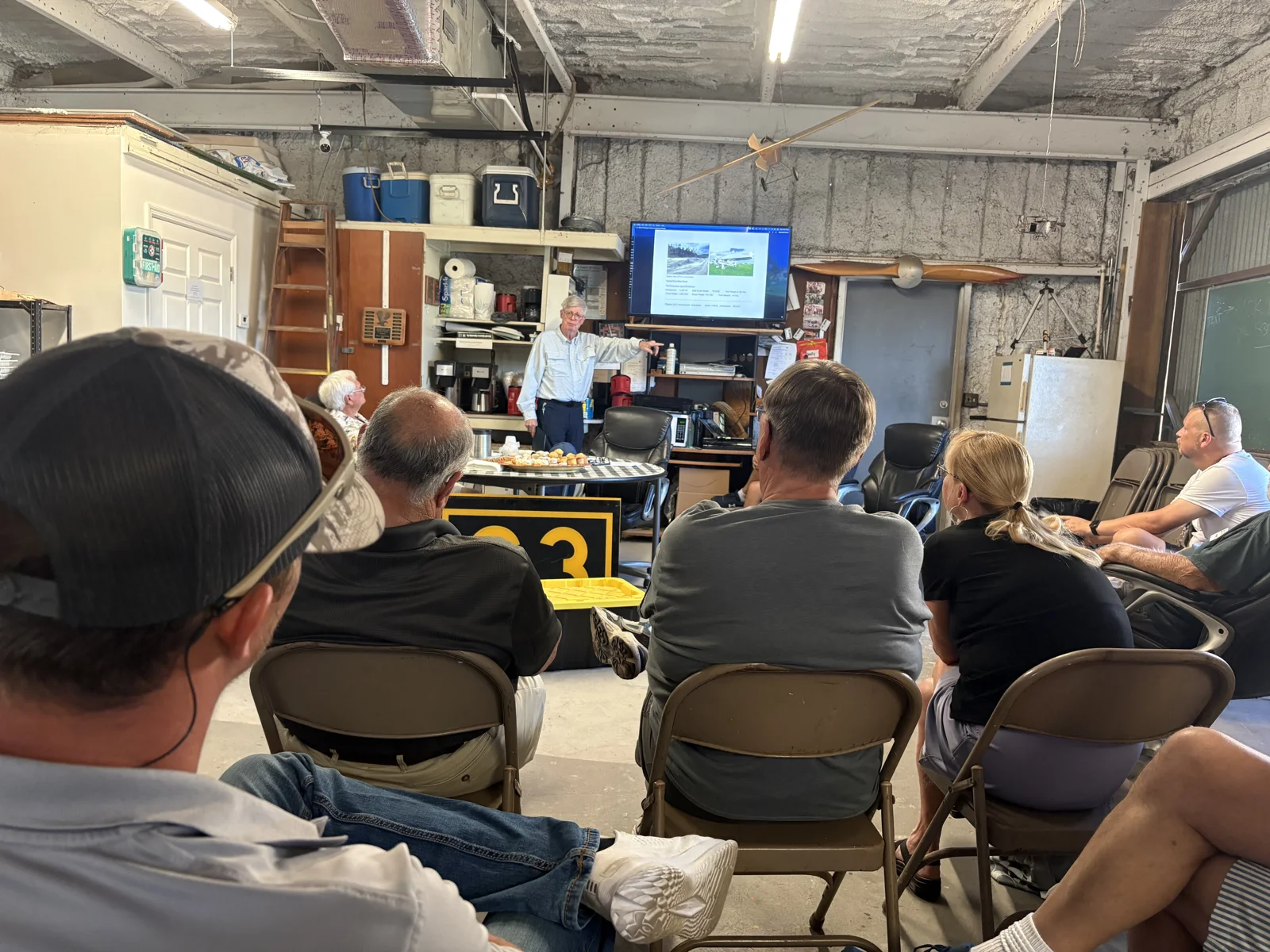
The video on the screen showed a single-engine airplane settling into a field — gear up, prop stopped, dust trailing behind it. Richard Belford let it play through. “That,” he said, “is the first thing the FAA shows you when you start training to be a designated pilot examiner.” He’d know. Twenty-four thousand hours, CFI-I, MEI, and a former FAA DPE himself, Richard has spent a career watching engines do exactly what engines sometimes do — quit — and he came to Hangar 100 last month to tell us what to do when ours does.
It started, fittingly, with a checklist. ABC. Airspeed. Best field. Cockpit check. Three letters the FAA hangs its emergency training on, and the spine of every story Richard was about to tell.
ABC, the Way the FAA Teaches It
The framework is simple on purpose. Airspeed first — get the nose to best-glide before anything else, because altitude buys time and airspeed buys glide. Best field second — pick the one you can actually reach, not the one you wish you could. Cockpit check third — run the emergency checklist, because every airplane has one and every airplane needs it.
And here’s the part Richard found most interesting: the FAA still wants a stabilized approach to your off-airport landing. Five hundred feet, configured, on speed — same as if you were landing on Runway 05 at KGIF Gilbert Field. The field may be a pasture, but the discipline is the same.
Six Engines That Quit
The stories came one after another, organized by airframe.
1. A Luscombe over central Ohio. Richard was right seat with a builder named John — no electrical, hand-prop only, glider rating and an aeronautical engineering degree. The engine quit on departure from a 1,580-foot grass strip the locals called “Augusta Acres International.” Richard saw the airport behind them and said so. John kept climbing toward a distant field instead. “Altitude buys options,” John told him. They slipped in over a wire and landed clean. Richard’s first engine failure — and his first lesson that the closest field isn’t always the right one.
2. A Luscombe of his own, alone, southeast Ohio. Delivering one of John’s airplanes down the Muskingum River toward West Virginia, the engine sputtered and quit mid-turn. He put it down on a strip-mine road — a coal-truck path with potholes the size of dining tables. Wheel landing, tail down, stopped. Then he flagged down a dump-truck driver who had never been near an airplane and talked him into holding the brakes while he hand-propped it back to life.
3. A Cessna 414 over Toledo. Flying a demo bird north for Lane Aviation, one engine started surging — early sign of low oil pressure. Richard shut it down, feathered, trimmed, and kept going to the destination on one engine. Toledo Approach offered to declare an emergency for him. “I’m fine,” he said. “We’re going to land where the mechanic is.”
4. A Cessna 421 Golden Eagle, both engines, short final at Rickenbacker. Cabin-class twin, fresh out of the shop for a Boston demo. Both engines started fluttering near Zanesville. He turned back. On short final, both quit completely with seventy-five feet to lose. He landed. The cause: the shop had never replaced the fuel filters. Years of crud had finally arrived in the lines on the same flight.
5. A Lake amphibian off KFLL. Just out of the paint shop, fresh out of Fort Lauderdale-Hollywood International. Four hundred feet on departure, the engine started to roughen. He cut power, dropped the nose, and put it on the taxiway next to the runway — no emergency declared, runway stayed open. Cause: the painters had stuffed a rag into the air intake to keep paint out, somebody put the air filter back on top of the rag, and nobody noticed. Blue paint and all.
6. A Piper PA-28 with a student named Otto, Highway 92. Otto was on his fourth lesson at KGIF, no wind, perfect morning, doing touch-and-goes on Runway 29. Thirty feet off the runway the engine quit. “My airplane,” Richard said. He coaxed a partial restart, threaded between two pickup trucks and a power line, put a wheel on Highway 92, and rolled it into a driveway. Cause: years of gunk in the fuel selector finally blocked the line.
What He Carries into Every Cockpit Now
Six engines, six different root causes — fuel, oil, contamination, neglect, age. Different airplanes, different airports, different decades. The common thread was the discipline that brought each one home: get the airspeed, pick the field, work the checklist.
Richard told us he should have run the full ABC every single time. On a couple of them, he didn’t — and he said so plainly. The honesty is the point. After enough engines quit on you, you stop pretending you’ll handle it perfectly and you start training the muscle that brings you home anyway.
These days, every student who flies with him gets the same surprise. Power back, no warning. “Can you make that field?” Sometimes yes, sometimes the answer is the field behind them or the road off to the right. They figure it out, they fly the approach, they land. Richard has signed off a long line of pilots and watched zero off-field landings on their checkrides since. “I don’t want anybody with my name in their logbook,” he said, “die in an airplane.” That’s the credo.
Join Us
Our next chapter meeting is Saturday, August 1, at 9:00 AM at Hangar 100, KGIF. Coffee will be on, the hangar door will be open, and whether you’ve got 24,000 hours or zero, there’s a seat for you. Bring your questions — Richard usually has a story for every one of them.